Last updated: August 10, 2026
- Key Facts – A starter emergency fund of $1,000 is a practical first milestone for many households.
- – A common longer-term target is 3 to 6 months of essential expenses.
- In practice, a $1,000 starter fund is a common first goal.
- I’d rather see a person build a $1,000 buffer than chase a perfect target they never reach.
Quick Answer: for most people, a useful emergency fund starts at $1,000, then grows to 1 month of essentials and eventually 3 to 6 months, depending on income stability and family needs. Build for a real shock, not a hypothetical one. Keep the cash easy to reach, though not easy to touch. This article on emergency fund rules mistakes — complete guide focuses on the common errors people make with amount, account choice, and use. The usual slip-up is not “saving too little” in the abstract. It is stashing money in the wrong place, for the wrong purpose, and then calling it an emergency fund when it is really a vacation fund, a tax bill fund, or a vague hope.
Key Facts
– A starter emergency fund of $1,000 is a practical first milestone for many households.
– A common longer-term target is 3 to 6 months of essential expenses.
– Keep emergency money separate from checking so it is less likely to be spent.
– Use cash or savings for true emergencies; use sinking funds for predictable expenses.
– For current rates and account types, compare a local bank, credit union, or high-yield savings account.
I’m writing this emergency fund rules mistakes — complete guide for the person who knows they need an emergency fund but keeps getting stuck on the details: how much, where to keep it, when to use it, and what to do if every dollar already has a job. I’ll give you the rules I trust, the mistakes I’d avoid, and the trade-offs no glossy personal-finance article likes to admit.
What an emergency fund is for, and what it is not
An emergency fund is money reserved for unexpected, necessary expenses that can’t wait without causing bigger damage.
Examples include things like:
- A job loss or sudden cut in hours
- An urgent car repair if you need the car to work
- A roof leak, broken furnace, or other home repair that can’t wait
- A medical bill or copay you truly have to cover now
- Travel for a family emergency, when there is no cheaper option
It does not include predictable spending that just feels annoying:
- Holiday gifts
- Annual insurance premiums you know are coming
- Back-to-school shopping
- A “mental health” shopping spree after a rough week
- A flight because you found a deal
- A repair that can wait a month if you plan for it
That boundary matters. If everything is an emergency, nothing is. A fund that gets drained for routine life is not a safety net; it is a leak. Honest truth? It turns into a money sieve fast.
One common mistake is using the word “emergency” to justify spending money that should have been assigned a different goal. When the expense is predictable, build a separate sinking fund for it. That keeps your emergency fund available when life actually gets messy.
How much to save: the rule I’d use first
The standard starting point is one month of essential expenses, then building toward three months, and sometimes more if your income is unstable.
That sounds simple, but the useful version is this: I would not start by asking, “How much should I save in total?” I would ask, “What would I need to survive if my income stopped for a while?”
Write down your bare essentials:
- Rent or mortgage
- Utilities
- Food
- Minimum debt payments
- Transportation
- Basic insurance
- Childcare if it is non-negotiable for work
- Any prescription or medical costs you must keep covering
That number is the real target, not your full lifestyle spending.
From there, I’d think in stages.
A practical three-stage approach
Stage 1: a starter fund
A small cash buffer can stop a minor crisis from becoming debt. For many people, that is a few hundred to a few thousand dollars, depending on income and living costs. I’m keeping that qualitative on purpose because the right number depends on your rent, your city, your insurance, and how stable your job is. In practice, a $1,000 starter fund is a common first goal.
Stage 2: one month of essentials
This is where the fund starts to feel useful. One month gives you breathing room for a layoff, a delayed paycheck, or a major repair.
Stage 3: three to six months of essentials
This is the classic target for many households. If your income is steady and your expenses are low, three months may be enough. If you’re self-employed, commission-based, seasonal, or supporting dependents, I would lean higher.
Who needs more, not less
You probably need a larger emergency fund if:
- Your income varies month to month
- You work freelance, on commission, or in seasonal jobs
- You have dependents
- You rent in a market where moving costs are high
- You have a high-deductible insurance plan
- You live far from family or support
- Replacing your income would take time
I would also build a larger cushion if losing one paycheck would immediately put you behind on rent or loan payments. People in that position do not need a theoretical rule; they need a buffer that keeps one bad month from turning into six.
The trade-off
A bigger emergency fund gives more safety, but it also ties up money that could be paying down high-interest debt or investing for the long term. There is no universal winner. I usually prefer enough cash to prevent panic and debt, then a balanced plan for everything beyond that.
If you carry very expensive debt, the emotional pull to over-save can become a trap. Some people feel safer with a huge cash pile even while paying steep interest elsewhere. That may be reasonable for a while, but it is not always the cheapest move. When debt is a serious issue, a financial professional can help you decide how to split each dollar.
Where to keep it so it helps you in a real crisis
The best place for an emergency fund is usually separate from your everyday checking account, easy to access, and protected from impulse spending.
I would avoid keeping it all in the same account you use for bills and groceries. If it sits there, it tends to shrink for reasons that never felt like emergencies at the time.
Good places to keep emergency money
- A separate savings account at your bank or credit union
- A high-yield savings account if you want better interest and can still access the money quickly
- A money market account, if the features and access work for you
The exact account matters less than the structure:
- It should be separate from spending money.
- It should be liquid.
- It should not punish you with delays when a real emergency hits.
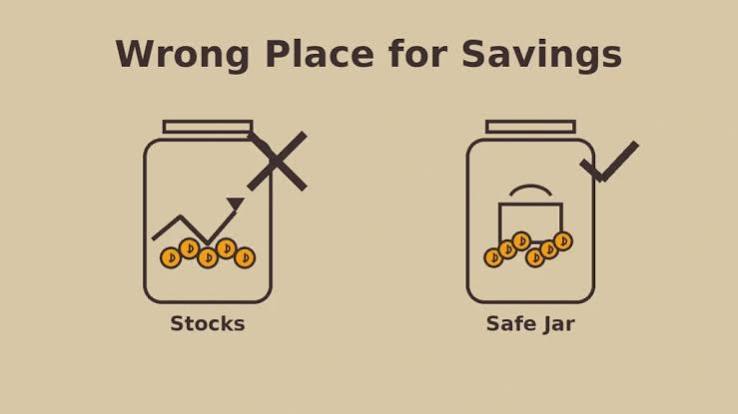
What I would not use for the main fund
- Stocks
- A crypto account
- Retirement accounts as the first line of defense
- Long-term CDs that charge penalties for early withdrawal
- Cash hidden at home in any meaningful amount
Those choices all have problems. Stocks can drop right when you need the money. Retirement accounts can trigger taxes and penalties. Cash at home can be stolen, lost, or simply too tempting.
A note on interest
People sometimes overfocus on the interest rate and miss the purpose. Your emergency fund is not there to earn the most. It is there to be ready.
If one account pays slightly better interest and another is more convenient, I’d choose the one that keeps the money accessible and separate. A tiny rate difference is not worth making your emergency fund hard to reach when the car dies or the furnace stops working.
For account comparisons and emergency-savings guidance, the Consumer Financial Protection Bureau explains why a separate, liquid account is the right structure for most households: https://www.consumerfinance.gov/
Emergency fund rules that actually help
These are the rules I would follow if I wanted the fund to work in real life, not just look neat on paper.
Rule 1: Give every dollar a job
Once money lands in your emergency fund, it has one job only: true emergencies.
That sounds obvious, but the rule matters because it stops goal creep. If you have $1,200 set aside, and you call a broken phone, a concert ticket, and a family trip “emergencies,” the fund disappears before it ever protects you.
Rule 2: Keep it separate from checking
If the money is mixed with spending cash, your brain treats it like available money. Separation creates friction, and friction protects the fund.
I like a separate savings account for that reason alone. It gives the money a different identity. When you are unsure how to separate savings from spending in a way that fits your situation, a bank, credit union, or financial professional can help you set it up safely.
Rule 3: Replace what you use
If you tap the fund, rebuild it as soon as you can. The point is not to feel guilty; it is to restore the buffer.
A practical approach is to set a refill plan immediately after the emergency passes. Even a small automatic transfer can help. If you are not sure how much to restore each month, a financial professional or nonprofit credit counselor can help you choose a plan that fits your budget. Without a refill plan, the next surprise lands harder. The CFPB also recommends rebuilding savings after a withdrawal: https://www.consumerfinance.gov/about-us/blog/starting-an-emergency-fund/
Rule 4: Adjust the target when life changes
Your emergency fund should not stay frozen while your life changes around it. Revisit it when:
- Your rent changes
- You get married or divorced
- You have a child
- You buy a home
- You move to a higher-cost area
- You change jobs
- Your insurance changes
- Your debt payments change
A fund sized for one season of life can be wrong in the next.
Rule 5: Use it without drama when the expense is real
Some people hesitate so long that a small emergency becomes a larger one. If the furnace breaks in January, delaying the repair can risk pipes, comfort, and safety. If you need a car for work, a delay can cost you income. The point of the fund is not to sit untouched forever. It is to absorb shocks.
The key is judgment, not guilt.
Mistakes that quietly wreck emergency funds
This is where a lot of generic advice gets shallow. The big problems are usually not dramatic. They are habits.
Mistake 1: Keeping the fund too close to spending
If your emergency money lives in checking, you will spend some of it. Maybe not on purpose, but it happens. A separate account is not a luxury. It is part of the system.
Mistake 2: Saving for emergencies while carrying expensive revolving debt with no plan
If you are making minimum payments on high-interest credit cards, then slowly building a large cash pile without a strategy, the math can work against you. I’m not saying “never save a dollar until debt is gone.” I am saying that in some cases, the order matters a lot.
A smaller starter fund first, then focused debt payoff, may be smarter than building a huge cushion while interest compounds. This is one of those places where a clean rule can fail. A financial adviser or nonprofit credit counselor can help if the numbers feel tangled.
Mistake 3: Using the emergency fund for predictable bills
This is the classic trap. Someone has an annual insurance payment, a car registration, or holiday spending. They pull from the emergency fund because the account is there, then they spend months refilling it. The fund becomes a revolving door.
The fix is simple but not easy: separate predictable irregular expenses into sinking funds.
Mistake 4: Making the goal too ambitious, then quitting
A lot of people hear “six months of expenses” and assume they should get there fast. Then they stall, feel behind, and stop saving entirely.
I’d rather see a person build a $1,000 buffer than chase a perfect target they never reach. A partial fund is still a real tool.
Mistake 5: Thinking the emergency fund is the entire plan
It is not.
An emergency fund helps with immediate shocks. It does not replace insurance, retirement savings, good budgeting, or basic risk management. If you skip insurance because you have cash, you are confusing convenience with protection. Cash can help, but it should not do every job. For longer-term planning and diversified savings, see your retirement plan provider or a fiduciary adviser.
Mistake 6: Not revisiting the number after a big life change
A fund that made sense when you were single in a studio apartment may fall short after you have kids, a mortgage, or a dependent parent in the picture. People forget this because the account balance looks familiar, even when life is not.
How to build one when money is tight
This is the part most articles wave away. If you had extra money, you would have the emergency fund already.
So here is the version for real budgets.
Start with the smallest useful buffer
When you cannot imagine saving months of expenses right now, start with a starter target that can handle the kind of surprise you actually get: a copay, a tire, a prescription, a late utility bill, a small repair.
That first buffer is not “too small.” It is proof that the system works.
Use automation if your paycheck is uneven
When income is irregular, I would not rely on willpower. Set up a transfer that happens after each payment, even if the amount changes. If you get paid in bursts, move a percentage into savings before the money gets absorbed by daily life.
Build from one expense cut, not ten
People often make emergency saving feel miserable by trying to cut every category at once. I prefer one clean move:
- Cancel one subscription
- Pause one habit spending category
- Redirect one debt payoff amount after a refinance or balance change
- Put one raise or side-income stream into savings before lifestyle creep absorbs it
That approach is easier to sustain.
Use windfalls with discipline
Tax refunds, bonuses, gifts, and cash from selling unused items can give the fund a quick boost. I would not count on windfalls as your only plan, but they are useful for acceleration.
Don’t confuse low cash flow with no options
A person can be broke in the sense of low current savings and still create room through timing, automatic transfers, a temporary side job, or by selling something they no longer use. The answer is often not “find more money magically.” It is “reorder the money already moving through your life.”
Local realities that change the rulebook
This topic is not one-size-fits-all, and that matters especially if you live where costs, weather, or job patterns change quickly.
I’m not going to pretend one national rule fits every household. In a place with high housing costs, a small emergency can be more damaging because there is less slack in the budget. In a region with harsh winters, a furnace or plumbing failure is not a theoretical risk. In a city with long commute times, car trouble can mean missed work and lost income.
If you live in a high-cost area such as Boston, Los Angeles, New York, San Francisco, Seattle, or a nearby suburb with similar rents, I would usually lean toward a larger cash buffer because replacing housing, transportation, or childcare can be expensive and slow. If your job is in a seasonal market, or your work depends on travel between suburbs and surrounding towns, the fund has to account for that volatility.
The same goes for service access. Someone in downtown Chicago, the Twin Cities, Dallas–Fort Worth, Phoenix, Atlanta, or a suburban area outside those metros may have different repair and housing costs, but the principle stays the same: your emergency fund should reflect the real expenses in the place you actually live, not a national average that may have nothing to do with your rent or commute.
I’d also be more cautious in places where storms, flooding, wildfire, freeze damage, or long power outages are part of the local reality. In those areas, your emergency fund may need to absorb not just the first repair bill, but the ripple effects: hotel costs, food spoilage, temporary transport, missed work, or a higher insurance deductible. A local insurance agent or financial professional can help you think through those risks without guessing.
A simple table for choosing your target and account setup
| Situation | Emergency fund target | Account setup I’d favor | Main trade-off |
|---|---|---|---|
| Stable salary, low fixed costs | Start small, then build toward 3 months of essentials | Separate savings account or high-yield savings | Lower cash drag, but less cushion |
| Variable income or commission work | 3 to 6 months of essentials, sometimes more | Separate savings with easy transfers in and out | More safety, but more money sitting idle |
| Single income household | At least enough to cover a serious interruption | Separate savings, clearly labeled | Ties up cash that could go elsewhere |
| High-cost city with steep rent and moving costs | Larger buffer based on local essentials | Separate savings, not mixed with checking | Harder to save, but more realistic protection |
| Heavy high-interest debt | Starter fund first, then a plan that balances debt and savings | Separate starter fund, then reassess | Must balance peace of mind against interest costs |
| Homeowner with older systems | Bigger fund for repairs and deductible gaps | Separate savings plus sinking funds for known repairs | More cash reserves needed up front |
This table is not meant to hand you a universal formula. It is meant to stop the most common mistake: copying someone else’s number without asking whether their life looks like yours.
How to use the fund without sabotaging it
When an emergency hits, the fund should do its job. The next step is what protects you from sliding backward.
First, confirm it is truly an emergency
Ask three questions:
- Is it unexpected?
- Is it necessary?
- Can it wait without causing worse damage?
When the answer is yes to the first two and no to the third, the emergency fund is probably the right tool.
Then, spend only what solves the problem
If a car repair has two options and one is safe, reasonable, and cheaper, I would not empty the account for the upgraded version. The fund is not there to improve the emergency. It is there to end it.
Afterward, make a refill plan
Treat the replenishment like a bill. If you used $600, put it back on a schedule. If your budget is tight, even a small recurring amount is better than hoping you “remember later.” If you are unsure how aggressive the refill should be, consult a financial professional or nonprofit credit counselor and use a source such as the CFPB’s emergency-savings guidance: https://www.consumerfinance.gov/
Watch for the next vulnerable month
A lot of people empty the fund, feel relieved, and then get hit again before it is rebuilt. That is when the real damage happens. If you know the next few months will be tight, lower your spending expectations early so the fund can recover.
Red flags: when an emergency fund idea is going sideways
I’d be cautious if any of these are true:
–