Last updated: August 10, 2026
- – Saving $20 to $25 per paycheck can build momentum without breaking a budget.
- $500 is a common starter target , and $1,000 is a stronger first milestone .
- For many workers, that is $40 to $50 a month .
- Quick Answer: Start with $500 to $1,000 if you can, then automate $20 to $25 per paycheck into a separate account.
Quick Answer: Start with $500 to $1,000 if you can, then automate $20 to $25 per paycheck into a separate account. This article covers ways save an emergency fund without cutting everything by using small, repeatable changes that fit a tight budget.
A broken water heater, a flat tire, or a surprise copay can hit at the worst possible moment. So the move is not to strip your life down to nothing. Instead, find small, repeatable dollars that barely change your day-to-day routine, then send them to savings before they vanish. That is the heart of ways save an emergency fund without cutting everything.
Key facts
– A starter emergency fund of $500 to $1,000 can cover common surprises like a copay or car repair.
– Saving $20 to $25 per paycheck can build momentum without breaking a budget.
– A separate savings account makes it harder to spend the money by accident.
– One-time money works best as seed money, then recurring transfers keep the fund growing.
– For many households, the goal is progress first, not a perfect fund.
The trick is cash flow. Not sacrifice theater. A solid emergency fund usually comes from a dozen small decisions, not one heroic month of misery. And the people who need it most are often the same people who cannot afford to feel punished by the plan.
Start with the right target: a small cushion first, not a perfect fund
A lot of people stall because they picture a “real” emergency fund as a giant pile of cash. Honestly, that picture can freeze you in place. I prefer a smaller first target: enough to handle a car repair, a copay, or a week of missed work. For many households, that first milestone is more useful than trying to jump straight to a full long-term reserve.
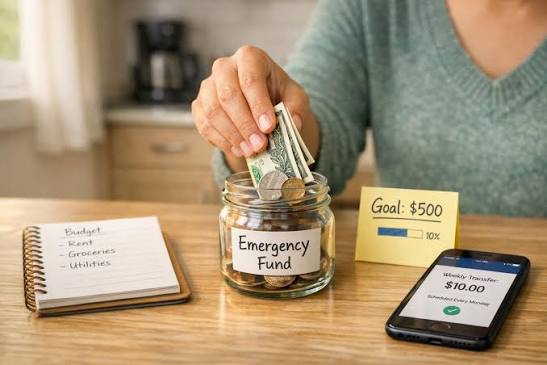
According to the CFPB, a small emergency buffer can help prevent a short-term setback from becoming a bigger financial problem. Need a number? $500 is a common starter target, and $1,000 is a stronger first milestone. Those amounts are not magical, but they are concrete.
For people already dealing with high-interest debt, I would not pretend it is separate from the savings question. You may need to split extra cash between debt payoff and savings so you do not end up borrowing again the first time something breaks. That trade-off is real. When every spare dollar goes to savings while credit card interest keeps climbing, the math turns ugly fast.
A useful rule: build a starter fund that keeps you from using a credit card for every surprise, then keep adding once the pressure eases. In a city with high rents or messy transit costs, that first cushion should reflect local reality. A minor repair in Chicago is not the same as a minor repair in a smaller town where you can wait a day for a cheaper appointment.
Use money you already have, but only once
The fastest way to begin is to redirect money already moving through your life and not miss it every month.
Here are the easiest places I would look first:
- A tax refund
- A bonus or overtime shift
- Cash gifts
- A work reimbursement
- A reimbursement from an insurance claim
- An old subscription refund or unused store credit
This works because it leaves your normal spending rhythm alone. But there is a catch: one-time money is not a plan by itself. Spend the windfall and never build a system, and the savings stop right there. So I would treat any lump sum as seed money, then set up a monthly transfer to keep it growing. And if your situation is complicated — or the windfall has tax or repayment strings attached — I would consult a financial professional. According to the IRS, tax refunds are often the easiest lump sum to redirect because they arrive as cash you were already expecting to receive.
Phoenix, Dallas, and Atlanta can be rough in a different way. Summer utility bills spike, storm costs show up, and a single roof leak, AC repair, or car battery replacement can wipe out a thin margin. That kind of surprise is a budget buzz saw.
Find savings in places that do not feel like punishment
Most budgets leak somewhere, but not every leak deserves attention. I would go after the expenses that can shrink without making life miserable.
Low-pain places to trim
- Automatic renewals you forgot about
- Bank fees
- Late fees
- Interest charges
- Food delivery fees
- One extra streaming or app subscription
- Insurance you should shop, not blindly keep
The point is to cut friction, not comfort. Canceling the subscription you barely use hurts less than banning all takeout. Switching to a checking account that avoids monthly fees is easier than giving up every convenience.
The dollar amounts are usually small at first, and that is fine. A $15 subscription, a $12 bank fee, or a $30 delivery habit does not sound dramatic alone, but a few changes can free up $50 to $100 a month. Enough to matter. Not enough to feel like a punishment.
Here is the trade-off: the easier the cut feels, the smaller it often is. A few dollars here and there will not build a big fund overnight. Still, those dollars show up every month, and steady beats dramatic if your goal is to keep going.
A simple local cost table
Seattle, Portland, and Boston tend to run pricier than many smaller markets, so these changes can matter even more there. If you live in a high-cost neighborhood, the same savings moves may free up less cash than they would elsewhere, which means you may need several at once.
| Savings move | What it usually means | Typical cash effect |
|---|---|---|
| Cancel one unused subscription | Remove a recurring charge you barely notice | Small but reliable monthly savings |
| Swap delivery for pickup or home cooking a few nights a week | Cut fees, tips, and markups | Modest to meaningful monthly savings |
| Switch to a no-fee bank account | Avoid account maintenance charges | Small recurring savings |
| Re-shop insurance at renewal | Compare rates before keeping the same policy | Sometimes small, sometimes significant |
| Move savings from checking the day you’re paid | Keep cash out of sight before spending | No direct cut, but often the most effective habit |
I am not putting a guaranteed number on those moves because that would be fake precision. The real result depends on your bills, your city, and your habits. A person in San Diego with high rent and a long commute will not free up the same cash as someone in a smaller suburb with lower fixed costs.
Automate the fund so you never have to “find” the money again
I would rather save by default than rely on willpower. Willpower gets tired. Automation does not.
Set up an automatic transfer the day after payday, even if it is small. Nervous? Make it tiny enough that you barely notice it. Saving $20 or $25 per paycheck is not flashy, but it can create momentum without forcing you to strip your budget down to the bone. For many workers, that is $40 to $50 a month.
When your pay varies, use a percentage instead of a fixed amount. Then the transfer rises when you have a better week and stays manageable when you do not. For hourly workers, freelancers, and tipped workers, that flexibility matters. A fixed transfer can bite too hard during slow periods, especially in cities with seasonal work swings or weather-dependent jobs.
Keep the emergency fund in a separate savings account, not in the same checking account where you pay bills. Out of sight helps. If the money sits right next to your debit card balance, it is too easy to reclassify “savings” as “available cash.”
One honest limitation: automation does not fix a budget that is truly underwater. If your rent, utilities, and debt payments already exceed your income, automatic saving may just create overdrafts. In that case, the first job is lowering the pressure, not forcing a transfer that breaks the account.
Make room by shrinking the expensive surprises, not your whole life
The biggest wins usually come from avoiding hidden costs, so I would target the expensive surprises that drain cash in sneaky ways.
Some examples that often help
- Pack lunch for work two days a week instead of five.
- Set a weekly cap on app-based ordering.
- Batch errands so you spend less on gas, parking, and impulse stops.
- Ask your utility company about budget billing or payment plan options if seasonal spikes are hurting you.
- Use the library, free community events, or neighborhood recreation instead of replacing all leisure with paid outings.
- Review car maintenance before a breakdown forces a bigger bill.
Parking-heavy neighborhoods, like parts of downtown Los Angeles, Washington, D.C., or Manhattan, can chew up money faster than people expect. Saving for an emergency fund there often means watching the “small” add-ons, not just the headline purchases.
There is a real balance here. I would not recommend cutting every dinner out, every coffee, and every social plan. That kind of extreme budget often fails because it breeds resentment. A sustainable plan leaves room for a life you can actually keep living.
Use timing to your advantage
Some months are easier than others, so I would work with those rhythms instead of fighting them.
When you get paid biweekly, saving gets easier in the two-paycheck months that land against four-week bill cycles. Seasonal costs matter too. In much of the Midwest, winter heating bills can tighten budgets. In parts of the South and Southwest, summer cooling costs do the same. Coastal areas can get hit by storm season and the repair costs that follow.
This is where a generic article usually goes sideways. It talks about “saving consistently” as if every month looks the same. It does not. A family in Minneapolis faces a different budget shape from a family in Miami. A renter in Queens has different risks than a homeowner in a flood-prone suburb.
Use that reality to your advantage:
- Save more in months when utility bills are lower.
- Put part of overtime or holiday pay aside before it disappears.
- If property taxes, back-to-school costs, or car insurance renewals hit at the same time every year, prepare for them in advance.
- If your work slows during a certain season, build the fund before that slowdown arrives.
That is not about being clever. It is about respecting your calendar.
Protect the fund from your own future self
Then make sure the money is still there when you need it.
I would keep the money in a separate high-yield savings account if one is available and the terms make sense for you. The point is not to chase a perfect rate. The point is to keep the money apart from everyday spending. If a slightly better rate comes with annoying transfer delays or account conditions you might miss, that trade-off may not be worth it for emergency cash. If you are unsure, consult a financial professional and compare the account disclosures before you move money.
Naming the fund in your own head can help too: car repairs, rent buffer, job-loss cushion, medical gap. That makes it harder to spend casually. It gives the money a job.
At the same time, do not lock it up so tightly that it becomes useless in a real emergency. Long transfer delays, withdrawal penalties, or obscure rules can backfire when the urgent bill lands. The best emergency fund is easy enough to use under stress and inconvenient enough to leave alone — but not so locked down that it cannot do its job.
What to do if you feel you cannot save at all
When your budget is so tight that every cut feels impossible, I would not say “just try harder.” That helps nobody.
Start with one of these:
- Save spare change from one category, not all categories.
- Round up transfers only when your account stays healthy.
- Pause one convenience purchase per week and move that amount immediately.
- Put every cash windfall into savings before it enters your spending pool.
- Split a tiny amount between savings and debt repayment so you build a cushion without ignoring interest.
This approach is slower. It is also more realistic for someone dealing with rent increases, childcare costs, medical bills, or irregular income. In expensive housing markets with long commutes — parts of the Bay Area, Northern New Jersey, or the Washington metro area, for example — slow progress may still be the right progress. The goal is not to feel virtuous. It is to keep the next surprise from turning into a crisis.
Local questions people ask when they need cash fast
People looking for emergency fund advice are often already under pressure. These are the questions I hear implied most often.
Can I build an emergency fund if I need money right now?
Yes, but I would start small. Keep the first target realistic and keep adding after the immediate pressure passes. If you need cash for this week, the fund’s job is to help with the next emergency, not the one happening today.
Is it better to save or pay debt first?
Sometimes both. When your debt is expensive and your savings are zero, I would usually aim for a small buffer while paying down debt. If you have no cushion at all, one surprise can send you right back into borrowing.
Should I use a credit card as my emergency fund?
I would not treat credit as a substitute for savings. It can buy time, but it also adds cost and stress. If you must use it, I would still build cash afterward so the same problem does not repeat.
What if I only have a free estimate of my monthly leftovers?
Then use that estimate as a starting point, not a promise. Save a small amount consistently and adjust after a few months. If your city has higher-than-average rent or utility swings, be conservative.
How do I know if a transfer amount is too high?
If it causes overdrafts, late bills, missed grocery runs, or repeated transfers back into checking, it is too high. I would lower it before the plan breaks.
The simplest version I would choose
If I had to boil all of this down, I would do four things:
- Open a separate savings account.
- Move one windfall into it.
- Automate a small transfer after payday.
- Trim only the recurring costs I barely use.
For a short how-to, that is the sequence I would use for ways save an emergency fund without cutting everything: start with one lump sum, automate the next deposit, then look for one or two recurring leaks you can close. A CFPB-style starter target of $500 is realistic for many households, and $1,000 is better if your bills are volatile.
That is enough to begin without turning your life into a long list of noes. Not glamorous. Not instant. Durable, though.
An emergency fund works best when it feels like part of real life, not a punishment for having one.